
To reduce security deposit disputes in Texas, document unit condition at move-in and move-out, then itemize every deduction against that baseline. Texas gives you 30 days after a tenant surrenders the premises to refund the deposit or deliver a written itemized list of deductions (Tex. Prop. Code § 92.103, § 92.104). Miss that, or withhold in bad faith, and your exposure is $100 plus three times the wrongful amount plus the tenant's attorney's fees (§ 92.109). Clean documentation is what protects you.
Where does your exposure sit at move-out in Texas?
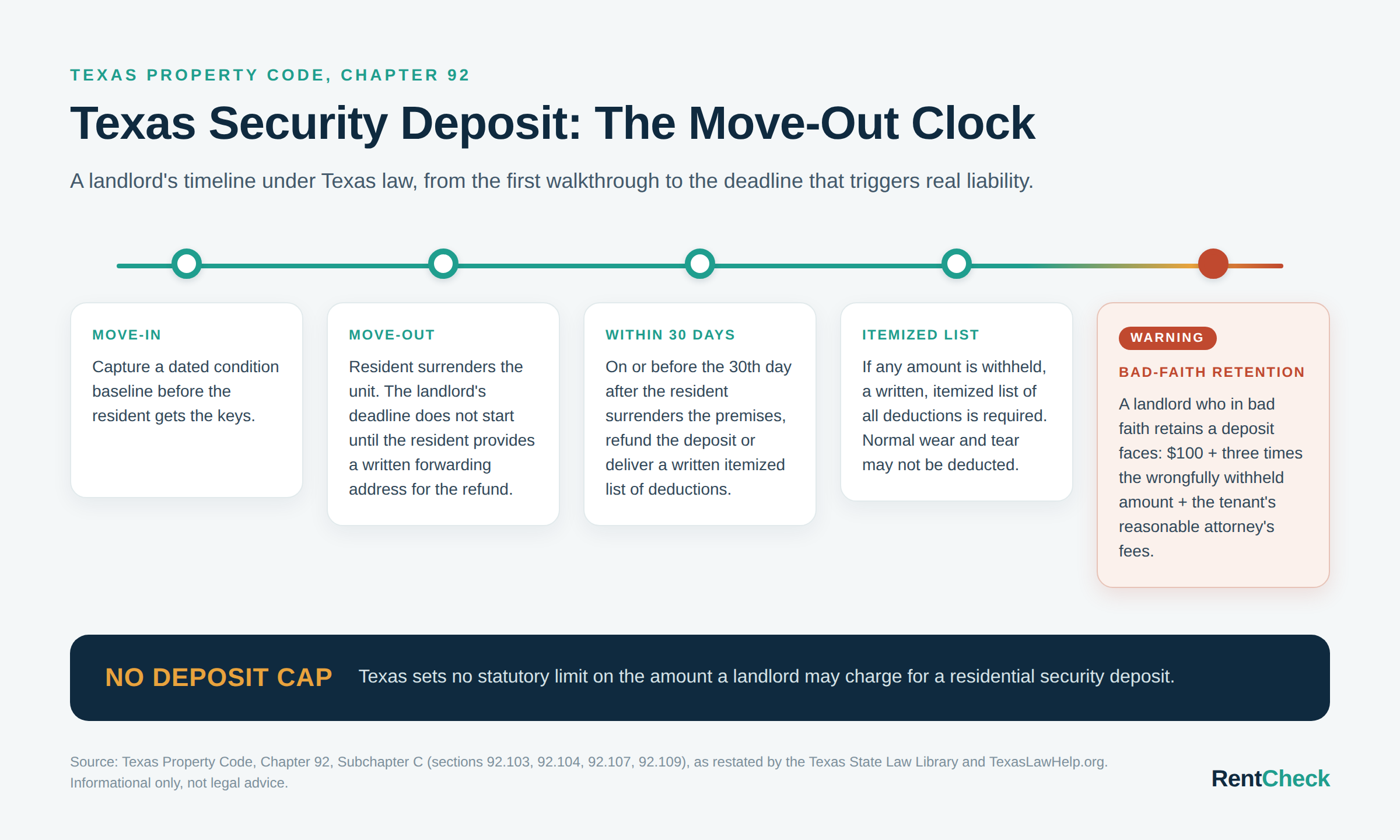
The risk is concentrated in a narrow window. Under Tex. Prop. Code § 92.103, you must refund the deposit, or deliver a written itemized list of deductions, on or before the 30th day after the tenant surrenders the premises. If you keep any portion of the deposit, § 92.104 requires a written description and itemized list of every deduction. You cannot withhold for normal wear and tear.
A few Texas-specific points raise the stakes for a PM company. There is no statutory cap on the deposit amount you can charge, which means the dollars at risk per unit can be large (Texas State Law Library). Bad-faith retention carries the $100 + three-times penalty plus the tenant's reasonable attorney's fees (§ 92.109). And the burden is on you, not the tenant: in a suit under this subchapter, the landlord has the burden of proving the retention was reasonable (§ 92.109(c)).
One operational detail that catches portfolios off guard: your 30-day clock and your obligation are conditioned on the tenant giving a written forwarding address (§ 92.107). Failing to provide one does not forfeit the tenant's right to a refund. It only suspends your deadline until the address arrives. So track that date per unit, because it is when your clock starts.
Why does documentation decide these cases?
Because the statute puts the proof on you. When a tenant challenges a deduction, § 92.109(c) requires the landlord to prove the retention was reasonable. A deposit dispute is, in practice, an evidence contest, and the party with dated, signed condition records wins it.
These contests are not rare. Disputes over withheld deposits account for a large share of the landlord-tenant cases that reach small claims court (Nolo). For a company overseeing 500 to 1,000-plus units, that is a recurring operational cost, not a one-off. Each contested move-out pulls staff time, can trigger the § 92.109 penalty stack, and exposes you to the tenant's attorney's fees if a judge finds bad faith.
The fix is not better arguments after the fact. It is a record created before the dispute, so the deduction is already documented against a known starting condition. See our overview of landlord-tenant disputes for the broader pattern.
What is a repeatable move-out workflow that protects you?
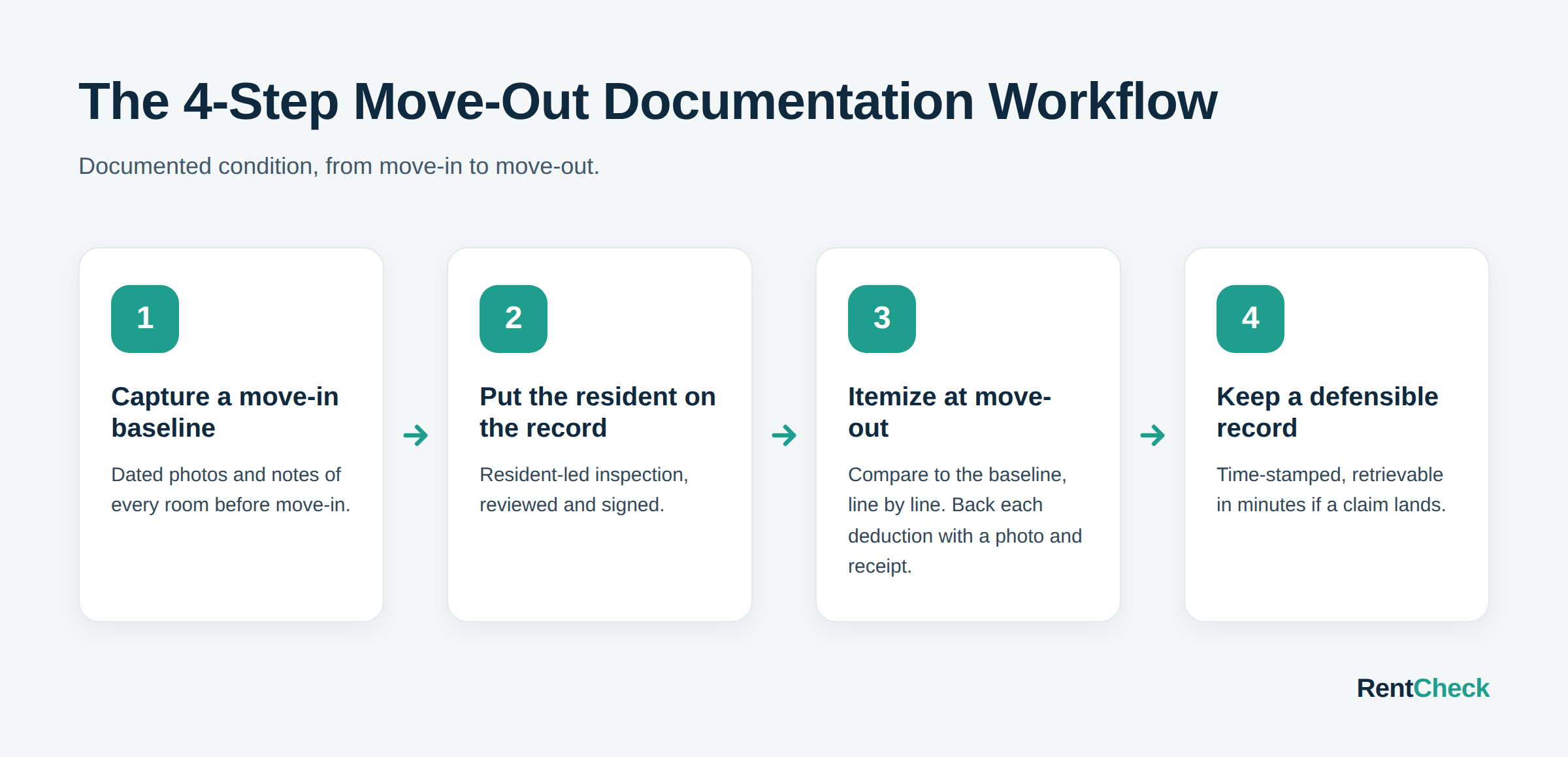
Use the same four steps on every unit, every time. Consistency is what makes the record defensible across a large portfolio.
- Capture a move-in baseline. Photograph and note the condition of every room before the tenant takes possession. This is the reference point every later deduction is measured against. A standardized move-in inspection gives every unit the same starting record.
- Get the checklist signed. A condition report the tenant reviewed and signed removes the "it was already like that" argument. Resident-led inspections put the tenant on record at move-in, which is exactly the documentation a judge looks for when the burden falls on you under § 92.109(c).
- Itemize at move-out against the baseline. Compare the move-out condition to the signed move-in record and list each deduction with its supporting photo. This is the written description and itemized list § 92.104 already requires, and tying each line to the baseline is what shows the deduction is not normal wear and tear.
- Keep a defensible time-stamped record. Store every inspection with its date so you can show the move-out itemization went out within the 30-day window from § 92.103. Time stamps answer the deadline question before it is asked.
RentCheck runs all four steps as one workflow, so every Texas move-out produces the dated, signed, itemized record the statute puts on you to prove with tenant-guided inspections. Get started with RentCheck and standardize move-out documentation across your portfolio.
FAQ
How long do I have to return a security deposit in Texas?
On or before the 30th day after the tenant surrenders the premises, you must refund the deposit or deliver a written itemized list of deductions (Tex. Prop. Code § 92.103). The clock is conditioned on the tenant providing a written forwarding address (§ 92.107).
What is the penalty for wrongly withholding a deposit in Texas?
A landlord who in bad faith retains a deposit is liable for $100, plus three times the portion wrongfully withheld, plus the tenant's reasonable attorney's fees (§ 92.109).
Do I have to send an itemized list if I keep part of the deposit?
Yes. If you retain any portion, you must provide a written description and itemized list of all deductions (§ 92.104). The exception is when the tenant owes rent at surrender and there is no controversy over the amount owed.
Is there a limit on how much deposit I can charge in Texas?
No. Texas sets no statutory cap on residential security deposit amounts (subsidized housing aside), per the Texas State Law Library.
Who has to prove a deduction was fair if a tenant sues?
You do. In a suit under this subchapter, the landlord carries the burden of proving the retention was reasonable (§ 92.109(c)), which is why dated, signed condition records matter.