
To reduce security deposit disputes in Florida, follow the statutory move-out timeline and back every deduction with dated evidence. Florida law gives you 15 days to refund a deposit if you make no claim. It gives you 30 days to send written notice by certified mail if you do. Miss that window and you forfeit the deduction. Documentation is what protects you.
Where does your exposure actually sit at move-out?
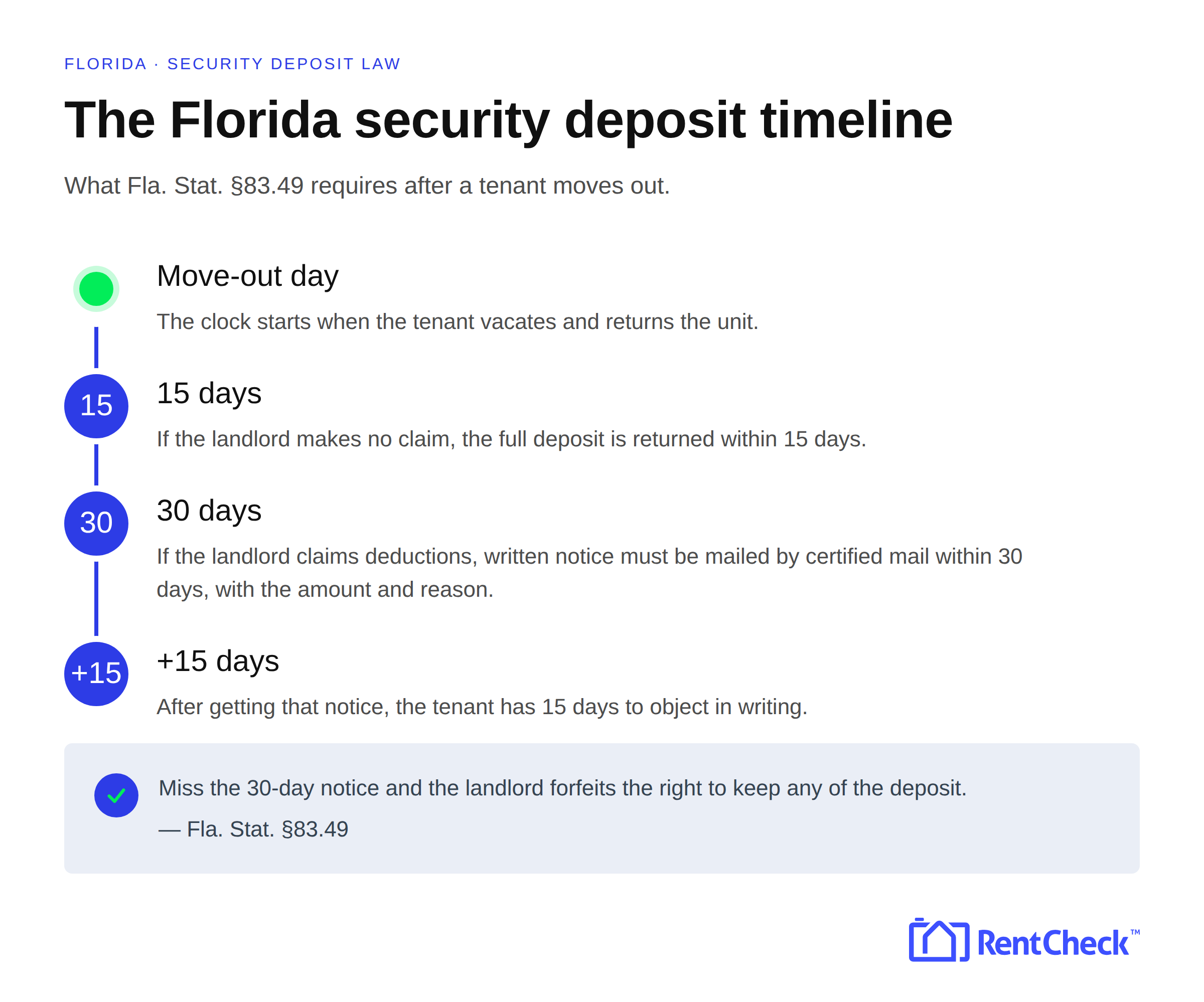
Your risk is concentrated in a narrow calendar. Under Fla. Stat. § 83.49, if you do not intend to impose a claim on the deposit, you must return it within 15 days after the tenant vacates. If you do intend to claim against it, you have 30 days to send the tenant written notice by certified mail to their last known address, stating your intention and the reason. Recent versions of the statute also permit email notice when the tenant has consented in writing, but certified mail remains the core method.
The penalty for missing the 30-day notice is severe. Fail to send it on time and you forfeit the right to impose any claim on the deposit. You can still sue for damages afterward, but only after returning the full deposit. The tenant then has 15 days from receiving your notice to object in writing. And if the dispute reaches court, the prevailing party is entitled to court costs plus a reasonable attorney's fee, payable by the loser (§ 83.49). For a company overseeing 500 to 1,000 units, a single missed certified-mail deadline can convert a legitimate charge into a total loss plus fee exposure.
Why does documentation decide these cases?
lorida sets no cap on residential deposit amounts (Nolo, citing Fla. Stat. §§ 83.43(13), 83.49, 83.491). Larger deposits mean larger disputes and larger fee awards when a claim is challenged. The statute does not ask whether the damage was real. It asks whether you can prove it, and whether you followed procedure.
When a tenant objects within their 15-day window, the question becomes evidentiary. Did the condition exist at move-in? Can you show the change? A deduction supported by a signed baseline and time-stamped photos is defensible. A deduction supported by memory is not. Most landlord-tenant disputes at move-out come down to a gap between what the manager remembers and what the record shows. Close that gap and most objections resolve before they reach a courtroom.
What is the repeatable workflow that protects you?
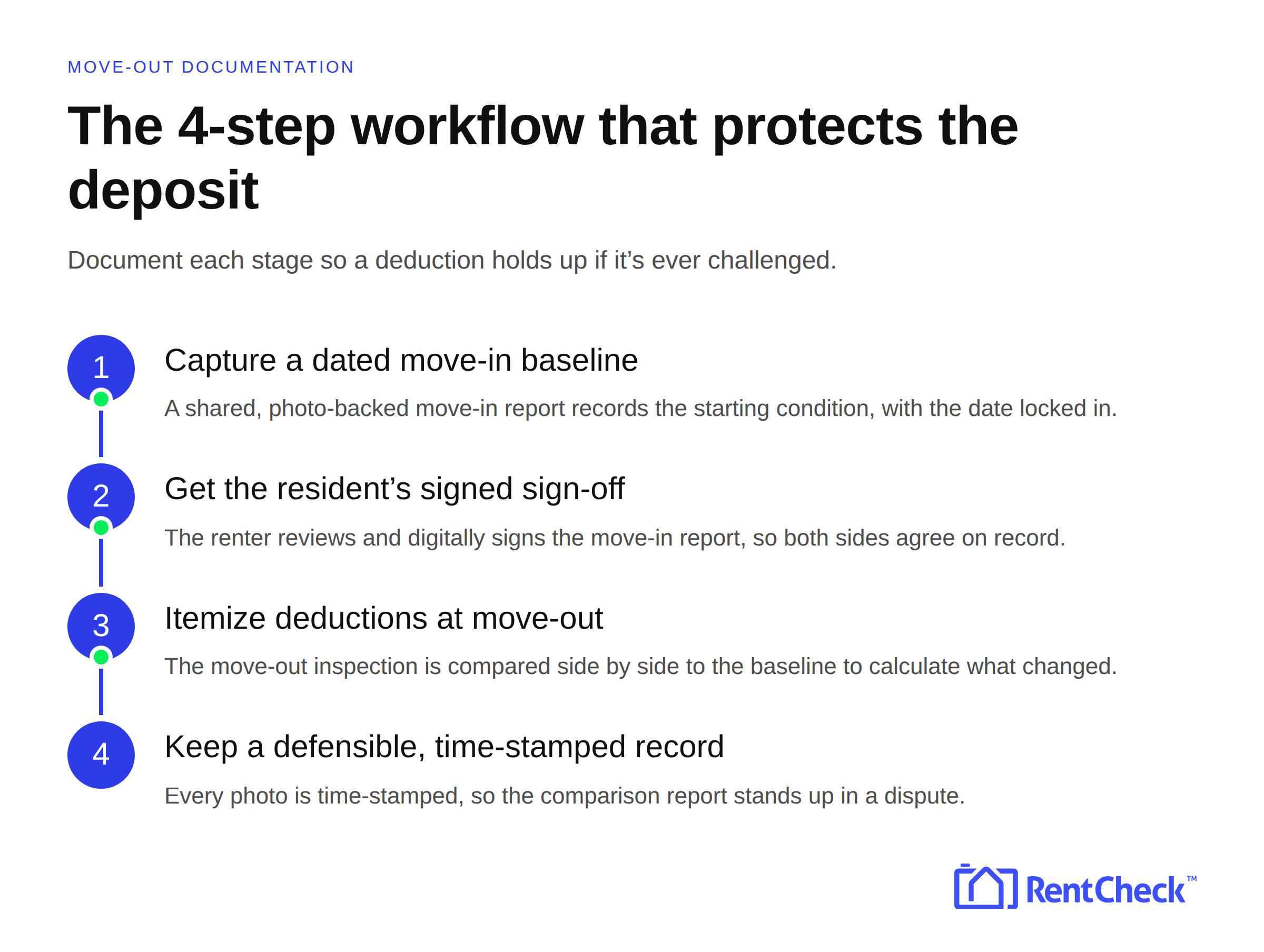
- Capture a move-in baseline. Document every unit at turn with dated photos before the resident takes possession. This is the reference point every later deduction is measured against. See RentCheck's guidance on move-in inspections.
- Get the checklist signed. A baseline the resident acknowledges is far harder to contest during the 15-day objection window. Resident-led inspections put the camera in the tenant's hands and capture their sign-off at scale, without sending staff to every door.
- Itemize at move-out against the baseline. Compare condition line by line. Tie each proposed deduction to a specific, dated before-and-after, so your certified-mail notice states a concrete reason and amount.
- Keep a defensible, time-stamped record. Every RentCheck inspection photo is time-stamped, so the record answers the "when" question on its own. At move-out, RentCheck's move-in and move-out comparison reports put both inspections side by side to show exactly what changed and itemize each deduction with photos. Retain the signed baseline, the comparison report, and proof of your certified-mail notice in one place, so if the tenant objects or files suit, your evidence is already assembled.
This is the same four-step workflow that scales. Monte Vista Properties used standardized, resident-led inspections to build a repeatable operation across a growing portfolio, documented in this case study. The point is not more work per unit. It is the same defensible record on every unit, every time, so no deduction rests on memory and no notice deadline slips.
If you manage hundreds of Florida units and want to reduce security deposit disputes in Florida with a consistent, court-ready record, get started with RentCheck.
Frequently asked questions
How long do I have to return a security deposit in Florida?
If you impose no claim, 15 days after the tenant vacates. If you intend to claim against the deposit, you have 30 days to send written notice by certified mail, then must remit any balance within 30 days of that notice (§ 83.49).
What happens if I miss the 30-day notice deadline?
You forfeit the right to impose any claim on the deposit and cannot take a setoff against it. You may still file a separate action for damages, but only after returning the deposit to the tenant.
Can a tenant fight a deduction, and what does that cost me?
Yes. The tenant has 15 days from receiving your notice to object in writing. If the dispute goes to court, the prevailing party receives court costs and a reasonable attorney's fee from the losing party, so a weak deduction carries real downside.
Is there a limit on how much I can charge as a deposit in Florida?
No. Florida has no statutory cap on residential security deposit amounts (Nolo, citing Fla. Stat. §§ 83.43(13), 83.49, 83.491). Section 83.49 governs how deposits are held and returned, not their size.