
Security deposit reconciliation is how property managers figure out what a departing resident actually owes for damage. You compare the unit's documented move-in condition against its condition at move-out, then charge only for the useful life the resident used up, not the full cost of the repair. Doing that defensibly takes two records: a dated starting condition and a known install date. Without both, the charge usually can't be proven.
A Boise property management firm recently made this case on LinkedIn: records are leverage, because they're what let a defensible charge actually hold up. When your documentation is solid, the math is clean. The resident pays for the useful life they consumed, and the owner absorbs the years that were used up before the tenancy began. When it's thin, the math falls apart. You can't charge for what you can't prove, so the owner eats the full cost of something that should have been split.
What makes a deposit charge defensible?
A charge holds up when you can answer two questions with evidence: how old was the component, and what condition was it in when the resident moved in?
Start with age. Useful-life math isn't optional accounting. HUD (U.S. Department of Housing and Urban Development) treats residential carpet as lasting about five to seven years, after which its depreciated value is effectively zero (Keyrenter, summarizing HUD guidance). So if a pet ruins a carpet that was already six years old, you're owed the value of the year or two that was left, not the price of new carpet. You can't run that math without the install date.Then condition. HUD's standard draws a hard line between normal wear, which a resident is never charged for, and damage, which they can be (HUD Appendix 5C/5D). Matting in a hallway is wear. A pet stain or a burn is damage. The only way to prove which one you're looking at is a timestamped record of how that component looked on day one.
Why do thin records cost you money?
Because the burden of proof sits with whoever makes the charge, and that's you.The deadlines are tight. California gives you 21 days after move-out to return the deposit or send an itemized statement (California Courts). Texas gives 30, and withholding in bad faith can cost three times the wrongful amount plus fees under Property Code §92.109 (Texas State Law Library). Miss a deadline or fail to back up a line item, and many states let the resident keep the deduction outright.
None of that is abstract. It's a specific dollar amount you were owed but can't collect . Multiplied across a portfolio turning 500 to 1,000-plus units a year.
Where do the records come from?
The install dates usually live in owner files. The piece most managers are missing is condition history, and that's where inspection software earns its place.
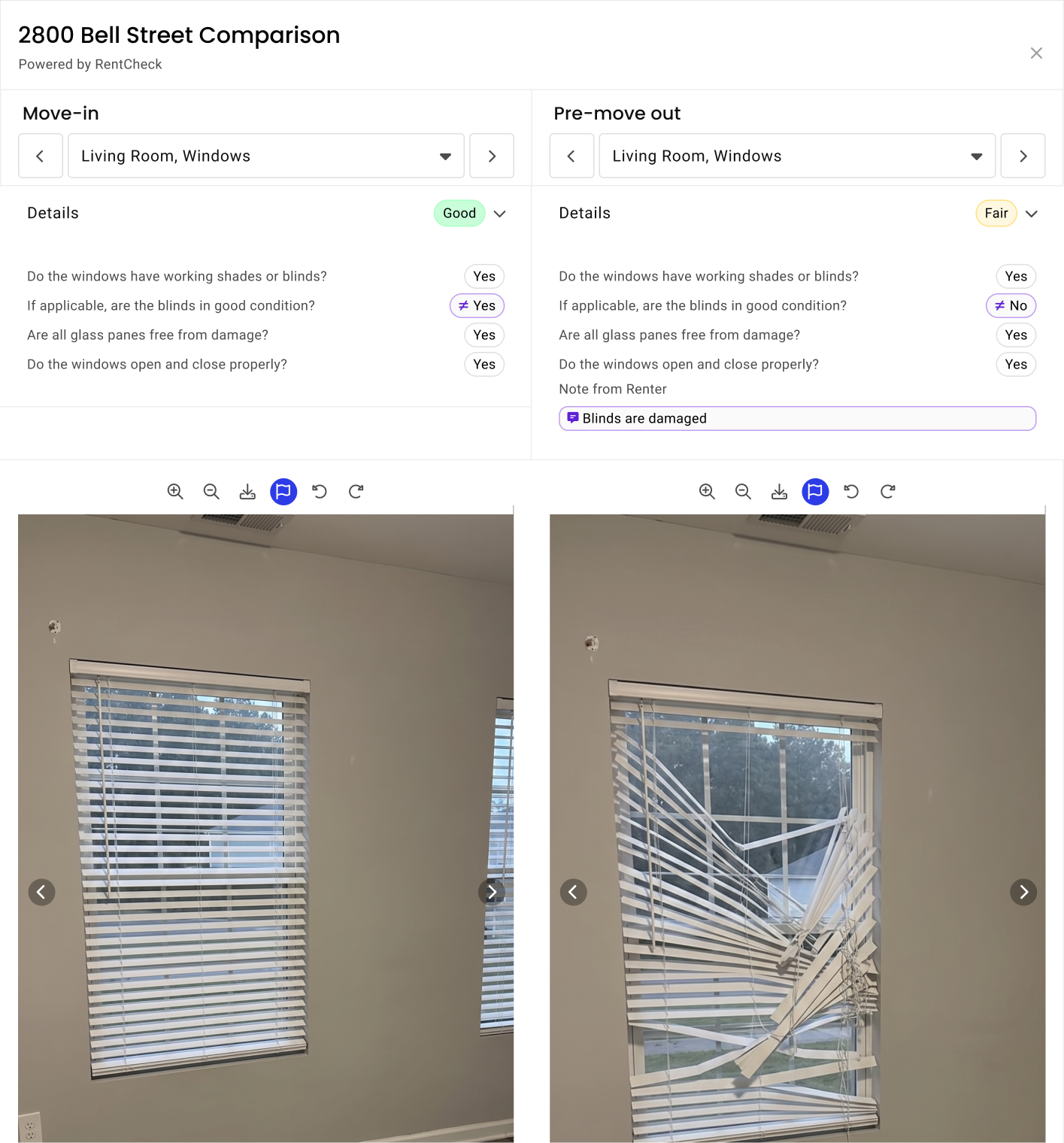
RentCheck's job is to timestamp condition. A move-in inspection produces a move-in report: the shared baseline for how every feature looked at the start. A later move-out inspection produces its own report, and the two are compared to calculate damages. Both ends are date-stamped photos, and the gap between them is the evidence your reconciliation rests on (product overview, reporting and data).
Two things matter at scale. First, the inspection report is customizable. You decide which sections and features show up, and which items require a photo — usually the ones most likely to be disputed. Standardizing that template is what makes condition history comparable across every unit, instead of varying by whoever did the walkthrough. Second, RentCheck supports resident-led inspections, where the resident does the guided walkthrough themselves. That saves your team a site visit and puts the resident on record documenting the condition — which turns a future "I never agreed to that" into a closed loop.
With a date-stamped baseline and a known install date, every charge turns into arithmetic anyone can check: replacement cost, minus depreciation for the years already used, minus normal wear, equals the resident's share. That's what defensible security deposit reconciliation for property managers comes down to — evidence, not whose call to the office was louder. To see how documented condition history changes your dispute rate, start a free RentCheck trial on a single property's next move-out.
FAQ
What is security deposit reconciliation?
The move-out accounting where a manager compares documented move-in and move-out condition, separates normal wear from chargeable damage, prorates each repair against the component's remaining useful life, and issues an itemized statement.
Can a property manager charge a tenant for old carpet?
Only for the remaining useful life. HUD treats carpet as lasting roughly five to seven years, so near or past that age you can bill only the prorated remaining value, not new carpet.
How many days do property managers have to return a deposit?
It varies by state — California requires return or an itemized statement within 21 days, Texas within 30. Miss it, and many states let the resident keep the deductions.