
To reduce security deposit disputes in California, professional property managers need a documented inspection trail from move-in to move-out. Photograph and date the unit before the resident moves in. Get the condition checklist signed. Itemize every deduction at move-out and attach receipts. A time-stamped record is what holds up when a deposit deduction gets challenged.
Where your exposure actually sits at move-out
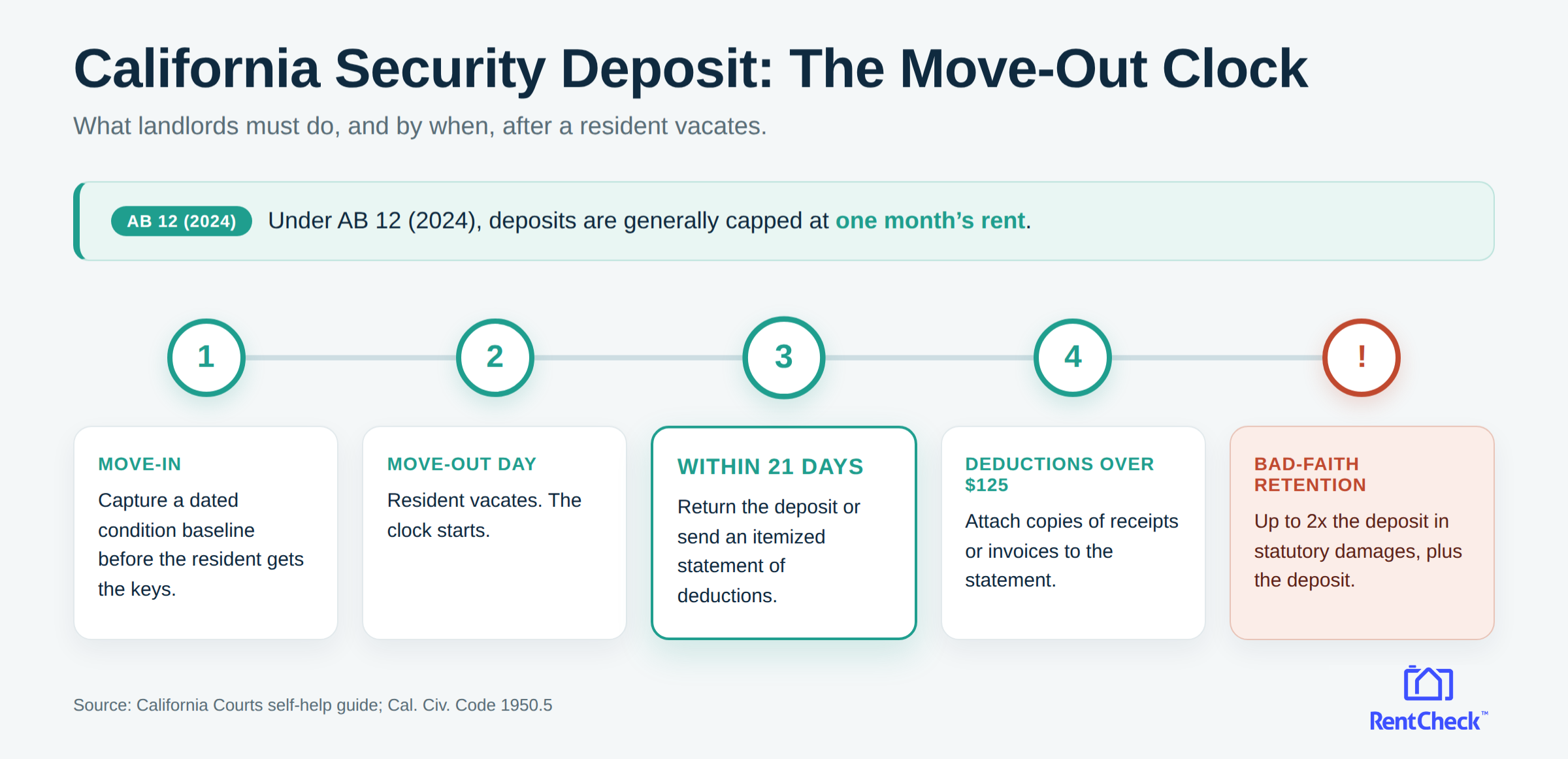
California gives you 21 calendar days to return a deposit or send an itemized statement of deductions (California Courts Self-Help Guide). Miss the window or deduct without proof, and the math turns against you fast.
If a court finds you retained funds in bad faith, the resident can recover up to twice the deposit on top of the deposit itself (Civil Code 1950.5). In practice, bad faith means keeping all or part of a deposit without a reasonable, documented basis, for example charging for damage you can't show or skipping the itemized statement. A clean inspection record is what keeps a deduction on the good-faith side of that line. Under AB 12, deposits in California are now generally capped at one month's rent, so your documentation has to carry more weight per dollar than it used to.
For any single deduction over $125, you must attach copies of receipts or invoices to the itemized statement (California Courts). No receipt, no defensible deduction. Across a 500 to 1,000 unit portfolio, that requirement repeats hundreds of times a year, and every gap is a potential claim.
The disputes are common. As many as 30% of rental disputes are over security deposits (Yardi Breeze). Filing a claim is cheap for the resident, which is part of why they pursue it: California small claims fees run $30 for claims up to $1,500 and $50 up to $5,000 (Superior Court of California Statewide Civil Fee Schedule). Your cost is not the filing fee. It is staff time, the potential double-damages penalty, and the operational drag of preparing for a hearing you may not win.
What decides these cases? Documentation quality
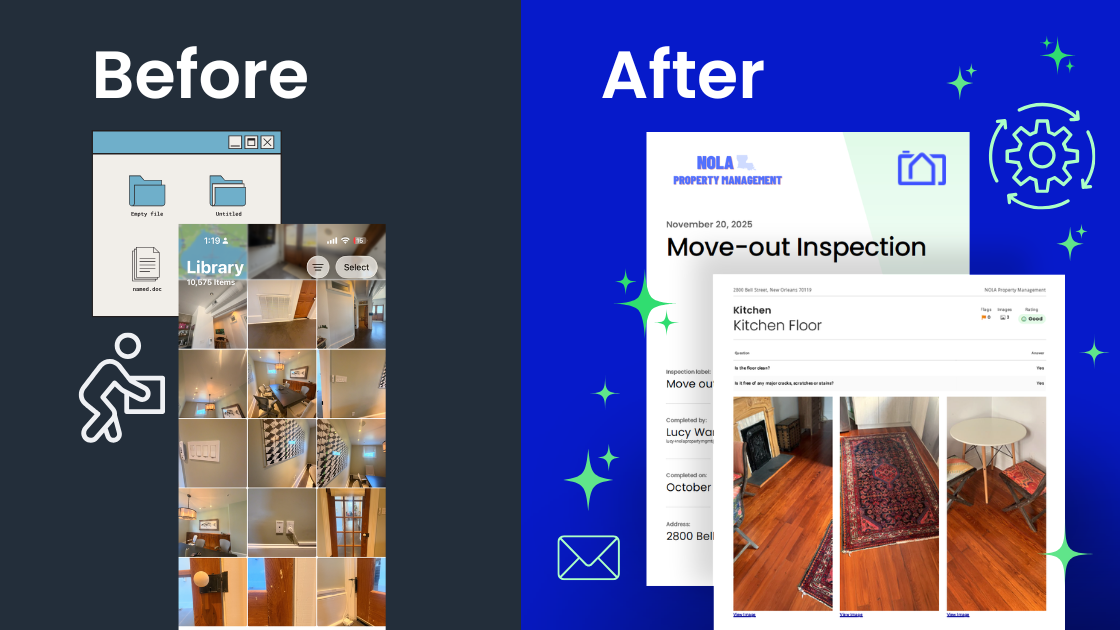
The outcome tracks the record, not the argument. In small claims court, tangible evidence is what wins a deposit case: move-in and move-out inventories, plus photos or video of the unit's condition (Nolo). California's own court guidance points managers to the same itemized, documented proof when a deduction gets challenged (California Courts). A manager who can produce a dated before-and-after has evidence. One who can't is arguing from memory.
So the question for a PM is not "are we following the law." It is "can we prove condition on demand, at scale, without burning a leasing team's week." That is a workflow problem.
The repeatable workflow that protects you
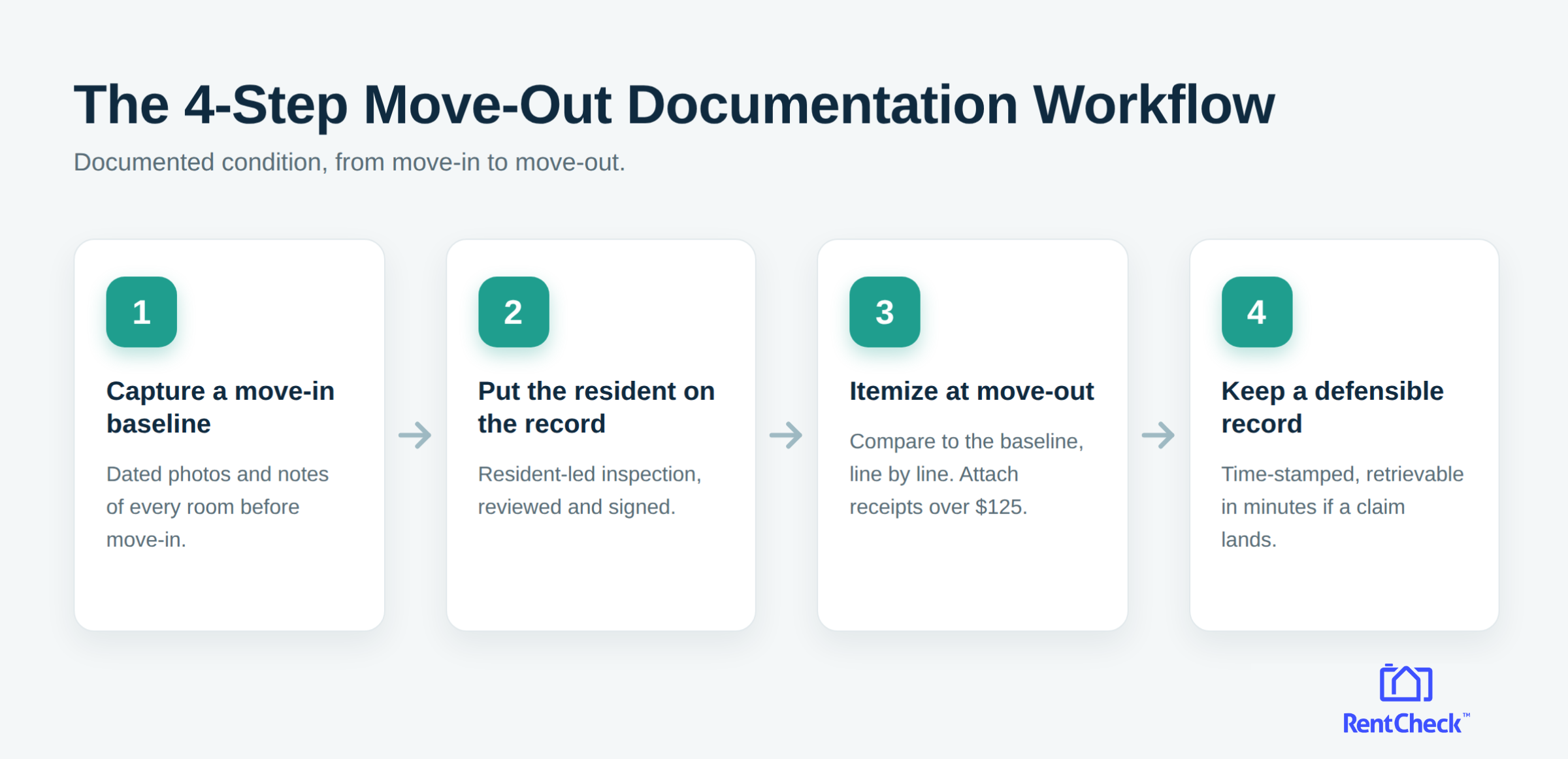
Four steps, applied to every unit, every turn.
1. Capture a move-in baseline.
Before the resident takes the keys, document every room with dated photos and notes. This is the reference point every later deduction is measured against. A structured move-in inspection gives you a fixed starting condition you can pull up two years later.
2. Get the checklist signed.
A condition checklist the resident reviews and signs removes the "it was already like that" argument. An unsigned report is a weak point in any dispute, so the signature is not a formality. It is the evidence.
3. Itemize at move-out against the baseline.
Compare current condition to the move-in record, line by line. Deductions tied to a documented before-and-after are far easier to defend than a flat charge. For anything over $125, attach the receipt at this step, not later.
4. Keep a defensible, time-stamped record. Every photo carries its own date. The itemized statement goes out inside 21 days. If a claim lands, you produce the full trail in minutes instead of reconstructing it.
One operational lever that lightens the load: resident-led inspections. The resident captures the condition themselves on guided prompts, which spreads the work off your team and produces a record the resident participated in, which is harder for them to later dispute.This holds up at portfolio scale. Monte Vista Properties used RentCheck to build a standardized, scalable inspection process across their units (case study), the kind of consistency that turns deposit defense from a fire drill into a standard step in the turn. RentCheck reports that consistent documented inspections help managers cut down on landlord-tenant disputes at move-out.If you want to standardize move-in and move-out documentation across your portfolio, start a free trial.
FAQ
How long do I have to return a security deposit in California?
21 calendar days from move-out, either the full deposit or an itemized statement of deductions (California Courts).
What documentation do I need to defend a deposit deduction in California?
A dated move-in baseline, a signed condition checklist, an itemized move-out statement, and receipts or invoices for any single deduction over $125 (California Courts).
What is the penalty for wrongly withholding a deposit in California?
If a court finds bad-faith retention, the resident can recover up to twice the deposit amount in statutory damages, plus the deposit itself (Civil Code 1950.5).
Does AB 12 change how much deposit I can collect?
Yes. As of 2024, deposits in California are generally capped at one month's rent, which raises the importance of clean documentation per unit.
Do photos really change dispute outcomes for property managers?
Yes. Legal guides are consistent that tangible evidence, move-in and move-out photos and signed inventories, is what wins a deposit case in small claims court (Nolo). Without that record, a manager has little to prove the claim with.